Eat That Frog: How to Stop Procrastinating and Focus on What Matters
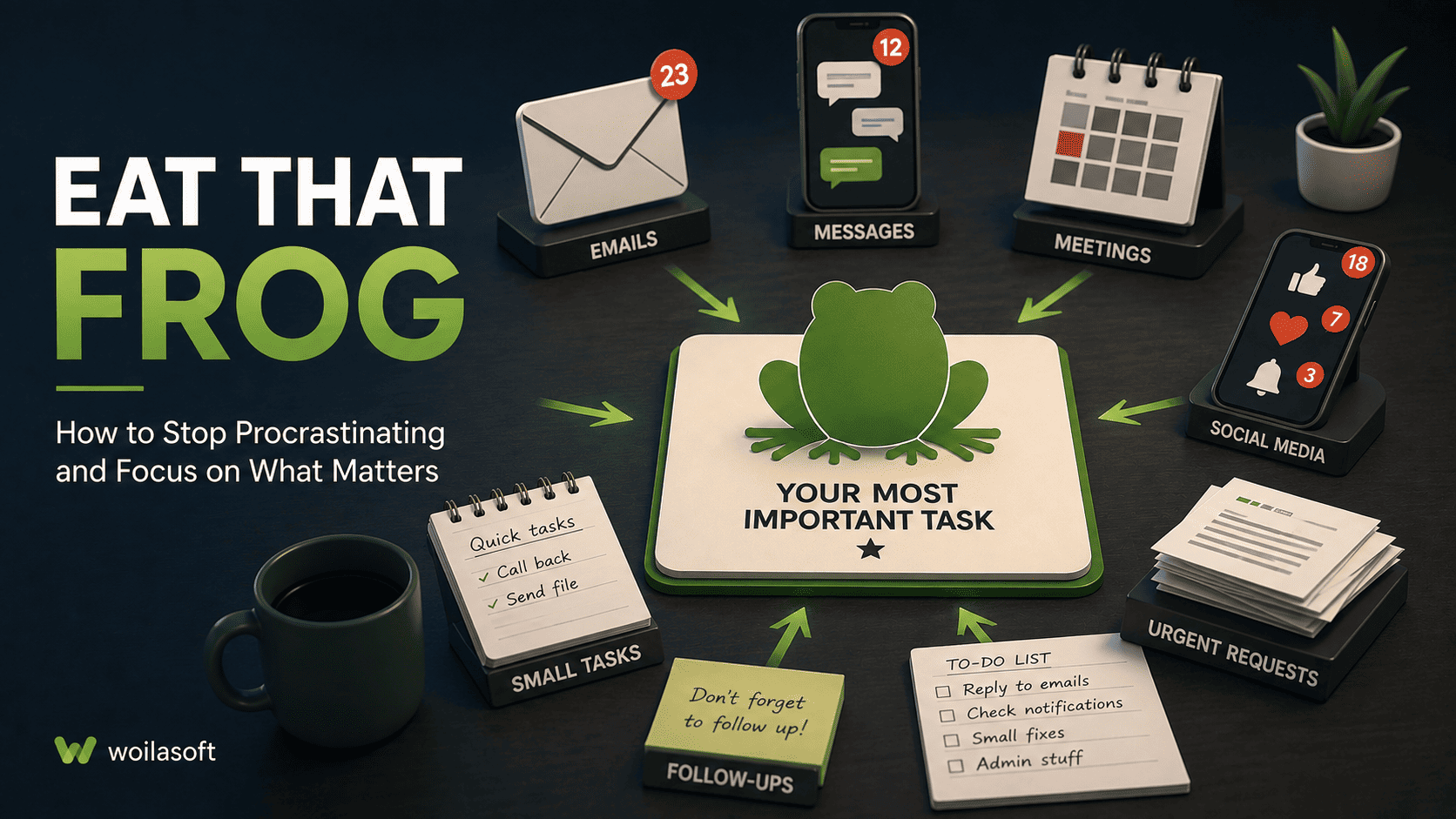
You can spend an entire day working and still feel like you accomplished nothing important. Emails, notifications, meetings, small requests, administrative tasks, and constant interruptions can easily consume the time you intended to dedicate to meaningful work. The Eat That Frog method offers a simple approach to this problem: identify the most important or difficult task of your day and tackle it first. In this article, we explore what Eat That Frog means, why we tend to postpone important tasks, how to apply the method in everyday work, and how productivity can go beyond personal time management through automation, digital tools, and artificial intelligence.
 M
M8/19/2026
Eat That Frog: How to Stop Procrastinating and Focus on What Matters
There is a particular kind of workday that can be surprisingly exhausting. You sit down in the morning knowing exactly what you should be working on. Maybe it's an important proposal, a difficult technical problem, a feature you've been postponing, or a decision that requires real thought. You open your laptop with the intention of finally getting it done. Then you check your email. You answer a message. You fix a small issue. You look at a notification. You quickly check something else. One small task becomes another, and another, until the morning is almost gone. Nothing you did was necessarily useless. And yet, the important thing is still waiting. I think this is one of the most interesting problems with productivity: procrastination doesn't always look like doing nothing. Sometimes, it looks like being busy all day.
The Idea Behind “Eat That Frog”
The idea was popularized by Brian Tracy in his book Eat That Frog!: 21 Great Ways to Stop Procrastinating and Get More Done in Less Time, first published in 2001. Tracy uses the “frog” as a metaphor for the most important and challenging task — the one that can have the greatest positive impact but that you are most likely to postpone. The metaphor itself comes from an old saying: if you had to eat a live frog first thing in the morning, you would at least have the satisfaction of knowing that the worst thing you had to do that day was already behind you. Tracy turned that idea into a practical productivity framework built around prioritization, discipline and action. What I like about the idea is how simple it is. Your frog is the task that matters most. It could be writing an important business proposal, solving a difficult technical problem, preparing a presentation, calling an important client, or making a decision you've been avoiding. The interesting part is that your frog is often not a mystery. You usually know what it is. You know which task would make you feel genuinely satisfied at the end of the day if it were completed. You also know which task keeps appearing on your to-do list and somehow survives every attempt to finish it. That is your frog. And the basic idea behind the method is simple:
Do that task first. Not because everything else is unimportant, but because important work tends to become harder to do once your attention has already been scattered across ten smaller things.

Why Being Busy Can Be Deceptive
This is where I think productivity advice often becomes confusing.
We tend to measure a productive day by how much we did.
How many emails did we answer? How many meetings did we attend? How many items did we remove from the to-do list?
But activity and progress are not the same thing.
Imagine spending two hours answering messages, checking notifications and fixing small problems. You could finish the morning feeling productive because you have done a lot.
Now imagine spending those same two hours solving a difficult problem that has been blocking an important project for several days.
You may have done only one thing.
But the second situation probably moved you much further forward.
 This distinction matters even more when you work in technology.
There is always something that can be improved. A dependency can be updated. A small bug can be fixed. An email can be answered. A new feature can be discussed.
There is an endless supply of small tasks.
The difficult work is different.
It requires concentration. It requires decisions. Sometimes it requires sitting with uncertainty for a while.
And that is exactly why we are tempted to avoid it.
This distinction matters even more when you work in technology.
There is always something that can be improved. A dependency can be updated. A small bug can be fixed. An email can be answered. A new feature can be discussed.
There is an endless supply of small tasks.
The difficult work is different.
It requires concentration. It requires decisions. Sometimes it requires sitting with uncertainty for a while.
And that is exactly why we are tempted to avoid it.
Why Do We Keep Postponing Important Tasks?
I don't think procrastination is always about laziness.
Sometimes the problem is that the task is unclear.
“Work on the application” is difficult to start because it doesn't tell you what the first action actually is.
“Design the authentication flow” is much easier.
Sometimes the problem is the size of the task.
“Build a mobile application” sounds enormous. It contains hundreds of decisions and smaller tasks hidden inside it.
But “define the application's architecture” is something you can actually sit down and do.
There is also another reason we procrastinate: important work can make us uncomfortable.
A difficult task can expose what we don't know. It can force us to make decisions. It can produce a result that someone else might judge.
So we look for something easier.
Checking email has a clear action: reply.
A notification gives us something immediate to look at.
A small bug has a clear beginning and end.
The important project may not.
And slowly, we can convince ourselves that we are making progress because we are doing things.
Movement isn't always progress.
 This is why I find the idea of “eating the frog” useful.
Instead of asking, “What do I feel like doing right now?”, you ask:
This is why I find the idea of “eating the frog” useful.
Instead of asking, “What do I feel like doing right now?”, you ask:
“What matters most today?” That question changes the starting point.
How to Actually Apply Eat That Frog
The method doesn't need a complicated productivity system. Before starting the day, write down the things that genuinely need your attention. Then look at them honestly. If you could complete only one of them, which one would make the biggest difference? That's your frog. The next step is to make the task specific. Don't write:
“Work on the project.” Write: “Implement the authentication API.” Don't write: “Prepare the business.” Write: “Finish the proposal for the client.” The difference may look small, but it changes the psychological weight of the task. A vague objective gives your brain room to postpone. A concrete action gives you somewhere to begin. Then give the task a real place in your day. If you decide that your frog deserves two hours of focused work, protect those two hours. Close unnecessary tabs. Silence notifications. Put the phone away if necessary. And then comes the part that is often harder than all the planning: start. You don't have to feel motivated. You don't have to feel completely ready. You just have to begin.
Once the important task is moving forward, the rest of the day often feels different. The smaller tasks are still there, but they no longer carry the same psychological weight because you know you've already made progress on the thing that mattered most.
 Once the important task is moving forward, the rest of the day often feels different. The smaller tasks are still there, but they no longer carry the same psychological weight because you know you've already made progress on the thing that mattered most.
What If Your Frog Is Too Big?
There is one problem with the metaphor.
Some frogs are enormous.
You can't realistically write “build the application” on your morning to-do list and expect to finish it before lunch.
That's not a task.
It's a project.
And projects need to be broken down.
Instead of “build a mobile application,” the first step might be defining the architecture. Then creating the project structure. Then setting up the database. Then implementing authentication. Then building the first feature.
Each of those steps is much easier to understand than the entire project.
This is something I find particularly important in software development. Large projects can feel overwhelming not because every individual part is impossible, but because we are looking at all of the parts simultaneously.
The solution is not always to work harder.
Sometimes it is simply to reduce the size of the thing in front of you.
You don't have to eat the whole frog in one bite.
Just take the first bite.
 You don't have to finish everything today.
You just need to make meaningful progress today.
You don't have to finish everything today.
You just need to make meaningful progress today.
But Productivity Isn't Always About Doing the Frog Faster
This is where I think the conversation about productivity becomes even more interesting. Once you've identified your important task, there is another question worth asking:
Does this task actually need to be done manually? Businesses spend enormous amounts of time on repetitive processes. Copying information from one system to another. Preparing recurring reports. Sending similar notifications. Entering data. Creating the same documents. Moving information between spreadsheets and applications. We often respond by trying to become faster at doing these things. But sometimes that's the wrong problem to solve. If you have to perform the same process every day, perhaps the answer isn't better time management. Perhaps the process should be automated.
This is one of the reasons I enjoy building software. Good software should not simply give people another place to enter information. It should remove unnecessary work. If a report can be generated automatically, why generate it manually every week? If a notification can be triggered automatically, why send it one by one? If information can move between systems without someone copying and pasting it, why keep doing it manually? Automation, custom software and AI can help with exactly this kind of problem. But I don't think the goal should be to automate everything. The goal is to automate the things that don't deserve your attention. That way, people can spend more of their time on decisions, creativity, relationships, strategy and other work where human judgment actually matters.
 This is one of the reasons I enjoy building software.
Good software should not simply give people another place to enter information.
It should remove unnecessary work.
If a report can be generated automatically, why generate it manually every week?
If a notification can be triggered automatically, why send it one by one?
If information can move between systems without someone copying and pasting it, why keep doing it manually?
Automation, custom software and AI can help with exactly this kind of problem.
But I don't think the goal should be to automate everything.
The goal is to automate the things that don't deserve your attention.
That way, people can spend more of their time on decisions, creativity, relationships, strategy and other work where human judgment actually matters.
This is one of the reasons I enjoy building software.
Good software should not simply give people another place to enter information.
It should remove unnecessary work.
If a report can be generated automatically, why generate it manually every week?
If a notification can be triggered automatically, why send it one by one?
If information can move between systems without someone copying and pasting it, why keep doing it manually?
Automation, custom software and AI can help with exactly this kind of problem.
But I don't think the goal should be to automate everything.
The goal is to automate the things that don't deserve your attention.
That way, people can spend more of their time on decisions, creativity, relationships, strategy and other work where human judgment actually matters.Eat That Frog Is Not a Rigid Rule
There is also a limit to the method. Not every day will go according to plan. A customer might have an urgent problem. A production system might fail. An unexpected opportunity might appear. Something genuinely important might change your priorities. In those situations, it would be ridiculous to say, “Sorry, I can't deal with this because I haven't eaten my frog yet.” The method should not become another source of stress. For me, the useful lesson is not “always do the hardest thing at exactly 8:00 AM.” It's much simpler:
Know what matters before everything else starts competing for your attention. Productivity is not about following a perfect routine every single day. It is about making better choices about where your limited time and attention go.
The Real Lesson: Do Less, Better
We have more productivity tools than ever. Calendars. Task managers. AI assistants. Automation platforms. Notes. Reminders. And yet it is still incredibly easy to spend an entire day doing things that don't move anything important forward. Maybe that's because productivity has never really been about having the perfect tool. It is about attention. What gets your attention gets your time. And what gets your time eventually gets your results. So tomorrow, before opening your inbox or jumping into the first notification you see, take a few minutes. Look at what you need to accomplish. Then ask yourself:
“If I could only accomplish one thing today, what would have the greatest impact?” That's your frog. Give it your best hours. Start before you feel ready. And if the frog is too big, take the first bite.
The Woilasoft Perspective
This idea also connects with the way I think about technology and the work we are trying to do at Woilasoft. I don't believe businesses need technology simply because having “a digital solution” sounds modern. Technology should solve a real problem. If a business is spending hours every week on repetitive work, the first question shouldn't always be how to make employees do that work faster. It should be whether the work can be simplified, automated or removed entirely. That's where software becomes much more than a tool. It becomes a way of changing how work is done. From web and mobile applications to business automation and AI integration, the goal is not simply to help organizations do more. It is to help them spend more of their time doing what actually matters. And maybe that's the part of Eat That Frog I find most useful. The lesson isn't simply:
Do the difficult thing first. It is also: Be intentional about what deserves your attention in the first place. Some things deserve your best hours. Some things can wait. And some things shouldn't be on your to-do list at all. Eat the frog. Then ask yourself what you can simplify, automate or eliminate. Because being productive isn't about filling every hour. It's about making the hours you have count.
Ecrit par :
MMOUSSA HASSANA
CEO & Co-founder